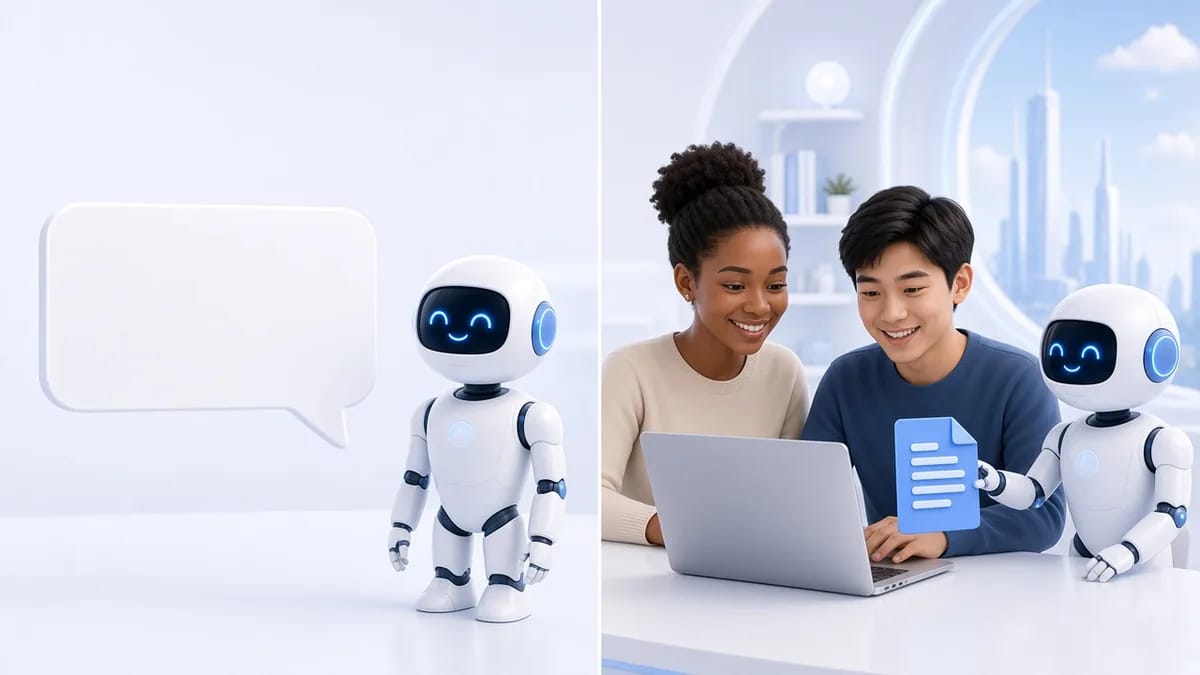
Generative AI in education usually appears as a tutor: it answers questions, generates examples, and checks your understanding. That helps knowledge. Career readiness, however, also requires procedural and social proof—handoffs, pushback, ambiguous assignments, and revision after review. AI teammates model those dynamics inside structured simulations. This guide compares tutors and teammates for learners and teachers deciding where to invest time, without treating either tool as a substitute for employment or a guarantee of hiring.
Two AI patterns, two different jobs
International guidance on generative AI in education stresses human-centred design, academic integrity, and clear learning goals. Those goals differ: mastering a concept versus demonstrating competency in a professional scenario. Picking the wrong pattern wastes limited study time and can mislead you into feeling "job-ready" when you only rehearsed explanations.
What career readiness actually requires
Career readiness is not a single test score. Frameworks such as NACE's career readiness competencies emphasize communication, critical thinking, teamwork, equity and inclusion, technology, leadership, professionalism, and career development—behaviours that show up across tasks, not in one chapter quiz.
- Knowledge: concepts, tools, regulations, and domain vocabulary
- Procedure: following workflows, using systems, meeting acceptance criteria
- Social: status updates, clarifying scope, receiving critique without defensiveness
- Evidence: artefacts and records employers or educators can review
AI tutors primarily accelerate the knowledge layer. AI teammates, when embedded in simulated internship structures, stress procedure, social cues, and evidence. Most learners need both layers over time; the question is which layer blocks you today.
Side-by-side: tutor vs teammate for readiness
| Dimension | AI tutor | AI teammate |
|---|---|---|
| Primary interaction | Question and answer, hints, generated examples | Assignments, handoffs, review, iteration |
| Best for | Concept gaps, exam prep, syntax and theory | Work samples, behavioural rehearsal, rubric scores |
| Feedback type | Correctness, explanation quality | Rubric-based, role-specific (manager vs QA) |
| Collaboration signal | Usually none | Multi-role threads and dependencies |
| Misuse risk | Over-reliance without understanding | Treating simulation as employment history |
| Teacher oversight | Prompt design, integrity policies | Scenario design, rubric alignment, debriefs |
When to prioritize an AI tutor
Choose tutor-first paths when diagnostics show you cannot yet perform baseline tasks in your target role—writing coherent SQL, interpreting financial statements, or applying security basics. Tutors compress the loop between confusion and worked examples.
- You are switching fields and need vocabulary and mental models quickly
- You failed knowledge-heavy screens and need structured repetition
- Your course lacks office-hour access and you need ethical, policy-aligned help
- You are preparing for credentials where exam mastery is the near-term gate
When to prioritize AI teammates
Choose teammate-first paths when you understand concepts but lack stories and artefacts from professional contexts—common for bootcamp grads, career changers, and students without employer-hosted placements.
- You need work samples with review history, not only GitHub tutorials
- Behavioural interviews expose weak examples of conflict, prioritization, or feedback
- You want rubric language aligned to career readiness competencies
- You learn better from stakes and deadlines than from optional exercises
For a longer exploration of teammate dynamics, pedagogy, and limitations, read How AI Teammates Change How We Learn—it goes deeper than this career-readiness decision frame.
A decision framework for learners
- Name the bottleneck: knowledge, proof, or access (e.g., no internship slot)
- If knowledge: pair courses with tutor-style practice; set mastery checks before simulation
- If proof: choose simulations with teammates, rubrics, and exportable records
- If access: use browser-based simulations while pursuing hosted placements in parallel
- Reassess monthly using scores and interview feedback—not vibes
Knowledge scarcity and abundance shift how we study—see The End of Knowledge Scarcity for context on why explanation alone is cheaper than ever while evidence still matters.
A decision framework for teachers and program leads
Teachers should map AI tools to measurable outcomes, not novelty. Tutors attach cleanly to learning objectives on content standards. Teammate simulations attach to performance tasks and work-based learning rubrics.
- Publish which activities allow generative AI and which require closed-book effort
- Use teammates for summative performance tasks only after formative tutoring milestones
- Debrief simulations: discuss what was artificial, what transferred, and what was hard
- Share capability records with advisers so coaching references the same rubric language
Review how Digital Internship structures AI roles if you evaluate platforms for classroom or independent study pilots—focus on role clarity and scoring, not chat novelty.
A blended four-week schedule (example)
Most learners need both explanation and execution. The schedule below is illustrative—adjust hours to your job target and institution's integrity rules.
- Week 1: Tutor-assisted concept sprint on one skill gap (e.g., SQL joins, stakeholder emails, basic analytics)
- Week 2: Closed-book self-check or instructor quiz; only proceed to simulation when baseline is met
- Week 3: Teammate simulation—one multi-step task with manager assignment and QA rejection loop
- Week 4: Publish a case study linking tutor notes (private) to scored deliverable (shareable)
If simulation feels too easy, increase ambiguity in the brief—not volume of tutor chat. If simulation feels impossible, return to tutor mode for one targeted subskill rather than abandoning the pathway.
Evaluating tools without marketing noise
- Tutor products: citation of sources, policy alignment, adaptive difficulty, export of your own notes
- Teammate products: named roles, rubric dimensions, revision history, teacher or mentor oversight options
- Red flags: "job guaranteed" language, anonymous team projects, black-box scores with no criteria
- Ask for a sample task transcript and scored output before annual purchase
Teammate simulations overlap with simulated internships when tasks mirror workplace deliverables. Tutors overlap with courses. Label what you used so interviewers understand which skills each artefact supports.
Limits both formats share
Neither tutors nor teammates pay wages, offer legal employment, or guarantee offers. Models can hallucinate; simulations can omit organizational politics; tutors can reinforce misconceptions if you do not verify answers.
Treat AI as practice infrastructure. Pair it with human mentors, real community projects when possible, and honest labelling on applications. Career readiness is a portfolio of evidence and relationships—not a single tool subscription.